How much does QRIS pay cost? This is what traders and buyers should know

How Much Does It Cost to Pay QRIS?
The question “how much does it cost to pay QRIS?” often comes to the minds of many people, both buyers and business owners. The answer needs a little explanation, because the cost of QRIS is not actually borne by the buyer, but rather by the merchant (seller).
The fee in question in the QRIS system is called MDR (Merchant Discount Rate), which is the fee charged to merchants for each transaction entered through QRIS. So, if you as a consumer pay IDR 100,000 via QRIS, you still pay IDR 100,000. There are no deductions or surcharges on the part of the buyer.
What is MDR QRIS?
MDR (Merchant Discount Rate) is the percentage of service charges deducted from each QRIS transaction that merchants receive. This fee is paid by merchants to Payment System Service Providers (PJSP) such as GoPay, OVO, Dana, ShopeePay, and others as compensation for the digital payment infrastructure services provided.
MDR QRIS is officially regulated by Bank Indonesia (BI), so the rates are uniform across payment platforms. No single application can charge MDR higher than the BI provision.
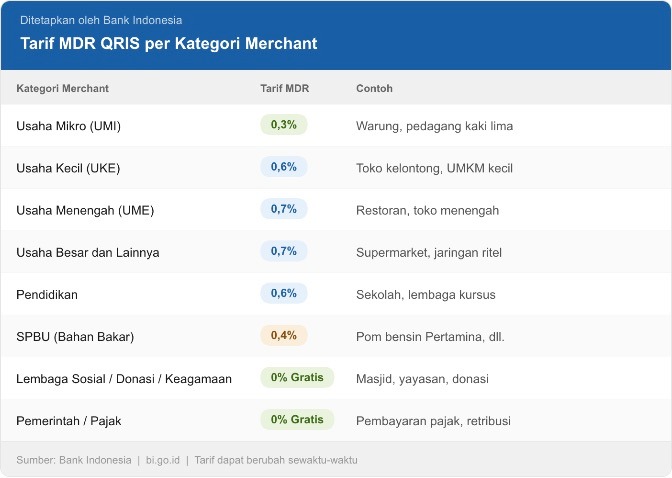
QRIS MDR Rates Per Merchant Category
Here is the official MDR QRIS rate table set by Bank Indonesia:
Example of MDR Calculation
Imagine you eat at a food stall (Micro Business category) and pay QRIS IDR 150,000:
- You pay: IDR 150,000
- MDR deducted from merchants: IDR 150,000 x 0.3% = IDR 450
- Which goes to the merchant account: IDR 149,550
So, the buyer has nothing to lose at all. The ones who bear the cost are the stall owners.
Are Consumers Charged When Paying QRIS?
Officially: no. Under the terms of Bank Indonesia, QRIS MDR fees should not be charged to consumers. Merchants are prohibited from requesting additional fees to the buyer for the reason for payment via QRIS.
But in practice, there are some merchants who add fees or request rounding on the grounds of “QRIS fees”. This is not in accordance with Bank Indonesia's terms and you have the right to reject it or report it.
What to Do If a Merchant Charges a QRIS Fee to a Buyer?
If a merchant asks for additional fees due to QRIS payments, you can:
- Remind the merchant that this is not in accordance with the terms of BI
- Report to Bank Indonesia via Contact Center BI at number 131
- Report through the official website bi.go.id
Static QRIS vs Dynamic QRIS
There are two types of QRIS you need to know:
Static QRIS
- The QR code does not change and can be used repeatedly
- Buyers enter their own transaction denominations
- Commonly used by MSMEs and small traders
- Simpler and easy to print
Dynamic QRIS
- The QR code is different for each transaction and contains a predefined nominal
- Buyers only need to scan and confirm as the nominal is automatically filled
- Commonly used in restaurants, convenience stores, and larger merchants
- Safer as each QR can only be used once
In terms of MDR fees, both are charged the same rate according to the merchant category.
{{alert-cta}}
Benefits of QRIS for Consumers and Merchants
For Consumers (Buyers):
- There are no additional fees when making a transaction
- Practical because one QR code can be paid from any application (GoPay, OVO, Dana, ShopeePay, etc.)
- Secure transactions recorded digitally and minimal risk of counterfeit money
- Proof of automatic transactions instantly appears in the app
For Merchant (Seller):
- No need for many EDC machines because one QR for all platforms
- Faster funds enter the account
- Digital transaction records make bookkeeping easier
- Affordable MDR, especially for microenterprises is only 0.3%
- Boosts buyer confidence as payments are more professional
So, the answer to the question “how much does QRIS pay cost?” are: free for buyers, paid for merchants in the form of large MDR regulated by Bank Indonesia, ranging from 0% for social and government institutions to 0.7% for large enterprises.
As a consumer, you don't have to worry about costs when paying QRIS. And if any merchant charges you a QRIS fee, it is not according to the rules and can be reported to Bank Indonesia.
QRIS is a secure, practical, digital payment system that has become an important part of Indonesia's financial ecosystem. Use it wisely!
Frequently Asked Questions (FAQ) about QRIS Fees:
1. How much does QRIS pay for buyers?
Zero rupiah. Buyers are not charged any fees when paying via QRIS. The MDR fee is fully borne by the merchant/seller according to the terms of Bank Indonesia.
2. How much is MDR QRIS for a small business?
Small businesses are charged an MDR of 0.6% per transaction. While microenterprises are lower, which is 0.3% per transaction.
3. Is MDR QRIS the same across all applications?
Yes. The QRIS MDR is set by Bank Indonesia and applies uniformly across all payment platforms (GoPay, OVO, Dana, ShopeePay, LinkAja, etc.). No platform should charge an MDR higher than the BI stipulation.
4th. Is there a QRIS registration fee for merchants?
Registration fees vary depending on the PJSP (organizer) chosen. Many platforms offer free QRIS registration for merchants, but some also charge certain administration fees. Check directly to the platform of your choice.
5. When is MDR QRIS cut?
The MDR is deducted automatically when a transaction occurs. The funds that go into the merchant account are clean after deducting the MDR.
6. Do social institutions and mosques incur QRIS fees?
No. Social institutions, donations, houses of worship, and religious activities are charged 0% MDR aka free. This is Bank Indonesia's policy to support social and religious activities.
7. Is QRIS safe to use?
Yes. QRIS is regulated and supervised directly by Bank Indonesia, using strict security standards. Always make sure you scan the QR from a trusted source and the transaction name is appropriate before confirming the payment.
8. What if the balance isn't enough but it's scanned QRIS?
The transaction will fail automatically if the balance is insufficient. No funding was cut. You can top up the balance first and then repeat the transaction.
9. Are merchants required to provide QRIS?
It is not required, but Bank Indonesia and the government strongly encourage merchants to use QRIS as part of Indonesia's economic digitization program.
10. Different bank but can pay QRIS?
Yes. This is the advantage of QRIS, which is interoperability. You can pay to any merchant using any app that supports QRIS, without worrying about bank or platform differences.
This article is written for educational and informational purposes. MDR rates and QRIS policies are subject to change at any time. Always check the latest information on the official website of Bank Indonesia: bi.go.id.

What are you waiting for?
Get your Honest Card today